
An island where more than half the land is wildlife refuge
Tree Service in Sanibel, FL
Careful pruning, invasive removal and storm recovery that follow Sanibel's vegetation standards.
- Free estimates, in person, for homes in Fort Myers and greater Lee County
- Itemized written price before any cutting
- Logs left or hauled, your call, agreed up front
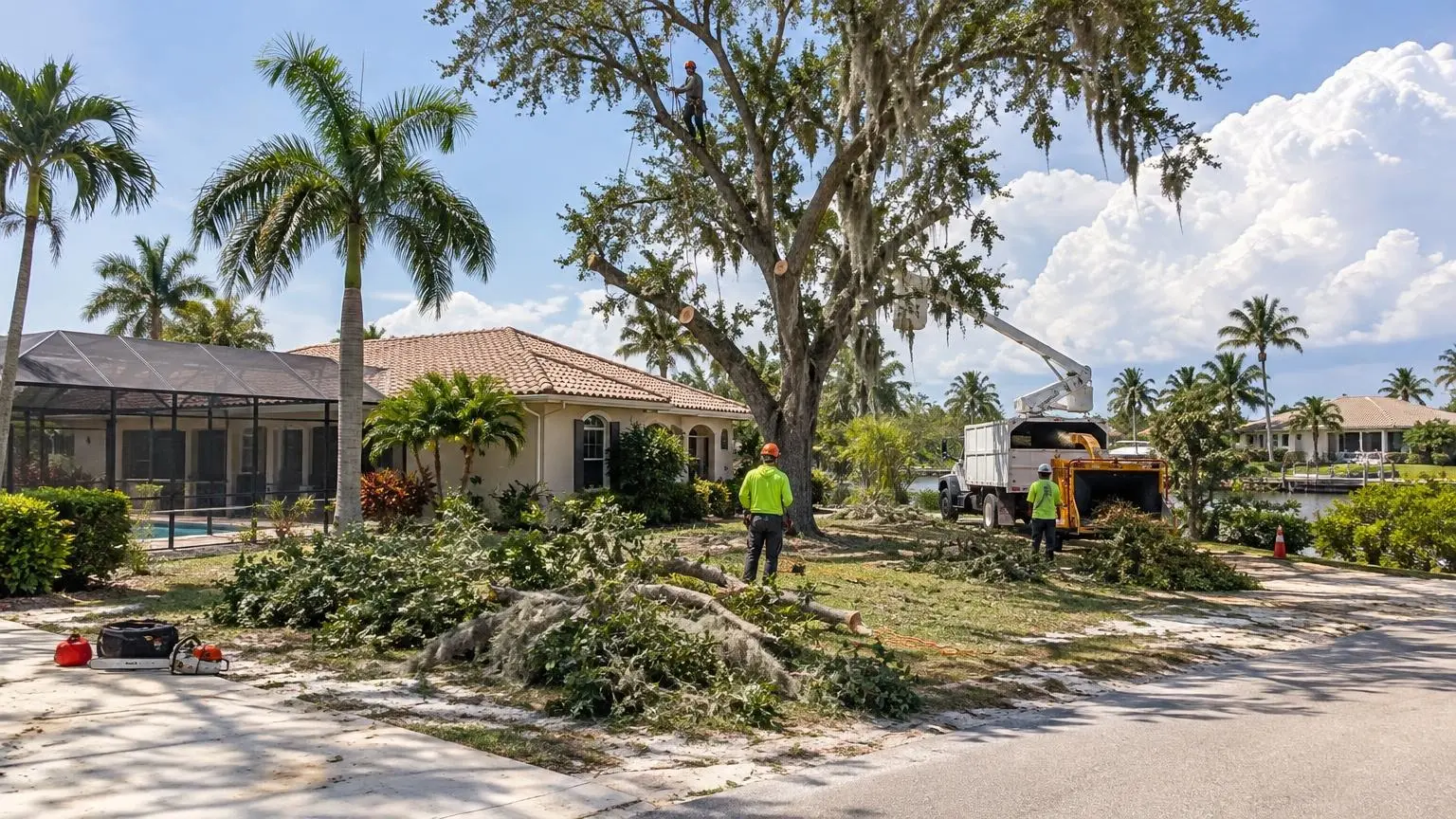
Sanibel Has Its Own Rules for Trees
Tree Service in Sanibel is regulated more closely than almost anywhere else in Southwest Florida, and for good reason. Since the city incorporated in 1974, after the 1963 causeway opened the island to rapid building, residents have used a comprehensive land use plan to keep development in balance with the island's ecology. The J.N. Ding Darling National Wildlife Refuge alone covers more than 5,200 acres. Fort Myers Tree Service Pros approaches Sanibel jobs knowing the island's vegetation standards are part of the job, not an obstacle to it.
What the vegetation standards ask of owners
According to the city's Vegetation Committee, at least 75% of the trees, shrubs and groundcovers on a property should be native, with up to 25% non-invasive exotics. Properties are to be kept clear of a list of eight invasive exotic plants, Brazilian pepper among them. Pruning of native plants is limited to 25% of the total leaf area in any one year. Moving or removing a protected native plant, trimming mangroves, and trimming in the beach and dune zone all need permits.
Who does the cutting
Sanibel requires a Vegetation Competency Card for landscape work beyond mowing, edging and blowing. The committee put it plainly: trimming or pruning requires the card. Getting one means passing a written test on the island's vegetation standards and a field plant identification test. Mangrove trimming has its own separate competency test, and all mangrove trimming is reported to the city. Ask anyone you hire on the island about these requirements before work starts.
Mangroves, living or dead
Florida's Mangrove Trimming and Preservation Act covers red, white and black mangroves. The state notes that the act does not distinguish between living and dead mangroves, so a mangrove killed by surge is still regulated. Many bayside lots on Sanibel have mangrove fringes, and we leave them alone unless the work is properly authorized.
What storms taught the island
When Hurricane Charley crossed in 2004 as a Category 4 with 143 mph winds, Australian pines suffered serious damage and blocked nearly every road, while most native vegetation survived. Australian pine is an invasive that shades out natives and drops thick needle beds that change the soil under it. Ian was harder still: the National Hurricane Center estimated 9 to 13 feet of surge on the eastern part of the island, where a USGS sensor measured 12.58 feet. On the east end in particular, many trees are still being judged for recovery.
Typical Sanibel work
- Removing Brazilian pepper, Australian pine and other listed invasives
- Light, staged pruning of sea grape, gumbo limbo and buttonwood within the yearly limit
- Removing palms and trees that died after Ian's surge
- Stump grinding and cleanup before native replanting
- Clearing limbs from roofs and screened lanais
LCEC supplies power on Sanibel and asks that only line clearance qualified workers trim within 10 feet of its lines. If a tree is touching a line, call the cooperative at 239-656-2300 first. For everything else, call (239) 236-3651 for a free estimate. Get a free estimate
Sanibel Vegetation and Storm Facts
- Native plant standard. Sanibel's vegetation standards call for at least 75% native trees, shrubs and groundcovers and limit pruning of native plants to 25% of total leaf area per year.
- Vegetation Competency Card. Trimming or pruning on Sanibel requires a city Vegetation Competency Card, earned by passing a written standards test and a field plant identification test; mangrove trimmers pass a separate test.
- Charley and Australian pines. Hurricane Charley's 143 mph winds in 2004 badly damaged Sanibel's invasive Australian pines, which blocked nearly every road, while most native vegetation survived.
- East-end surge in Ian. The National Hurricane Center estimated 9 to 13 feet of surge on eastern Sanibel during Hurricane Ian, with a USGS sensor reading of 12.58 feet.
Sanibel Questions
How much can I prune my sea grapes on Sanibel?
Sanibel's vegetation standards limit pruning of native plants to 25% of total leaf area in any one year. If a hedge or tree needs more than that, the work is usually spread over two or more years.
Do I have to remove Brazilian pepper from my property?
Sanibel's standards say properties should be kept clear of eight listed invasive exotics, and Brazilian pepper is one of them. We can cut it, treat the stumps so they don't resprout, and haul the debris off the island.
A mangrove on my lot died after Ian. Can I just cut it down?
Not without authorization. The state's mangrove act applies to dead mangroves the same way it applies to living ones, and Sanibel requires mangrove trimming to be reported to the city.
Free Estimates in Sanibel, FL
Free estimates on Sanibel, from the lighthouse end to Blind Pass.
Tree Service Near Sanibel
- Tree Service in Fort Myers, FL
- Tree Service in Cape Coral, FL
- Tree Service in Lehigh Acres, FL
- Tree Service in Estero, FL
- Tree Service in Bonita Springs, FL
- Tree Service in Fort Myers Beach, FL
- Tree Service in Captiva, FL
- Tree Service in North Fort Myers, FL
- Tree Service in Iona, FL
- Tree Service in San Carlos Park, FL
- Tree Service in Three Oaks, FL
- Tree Service in Villas, FL
- Tree Service in McGregor, FL
- Tree Service in Whiskey Creek, FL
- Tree Service in Cypress Lake, FL
- Tree Service in Gateway, FL
- Tree Service in Buckingham, FL
- Tree Service in Alva, FL
- Tree Service in Fort Myers Shores, FL
- Tree Service in Tice, FL
- Tree Service in St. James City, FL
- Tree Service in Bokeelia, FL
- Tree Service in Matlacha, FL
- Tree Service in Punta Gorda, FL